
| Availability: | In stock |
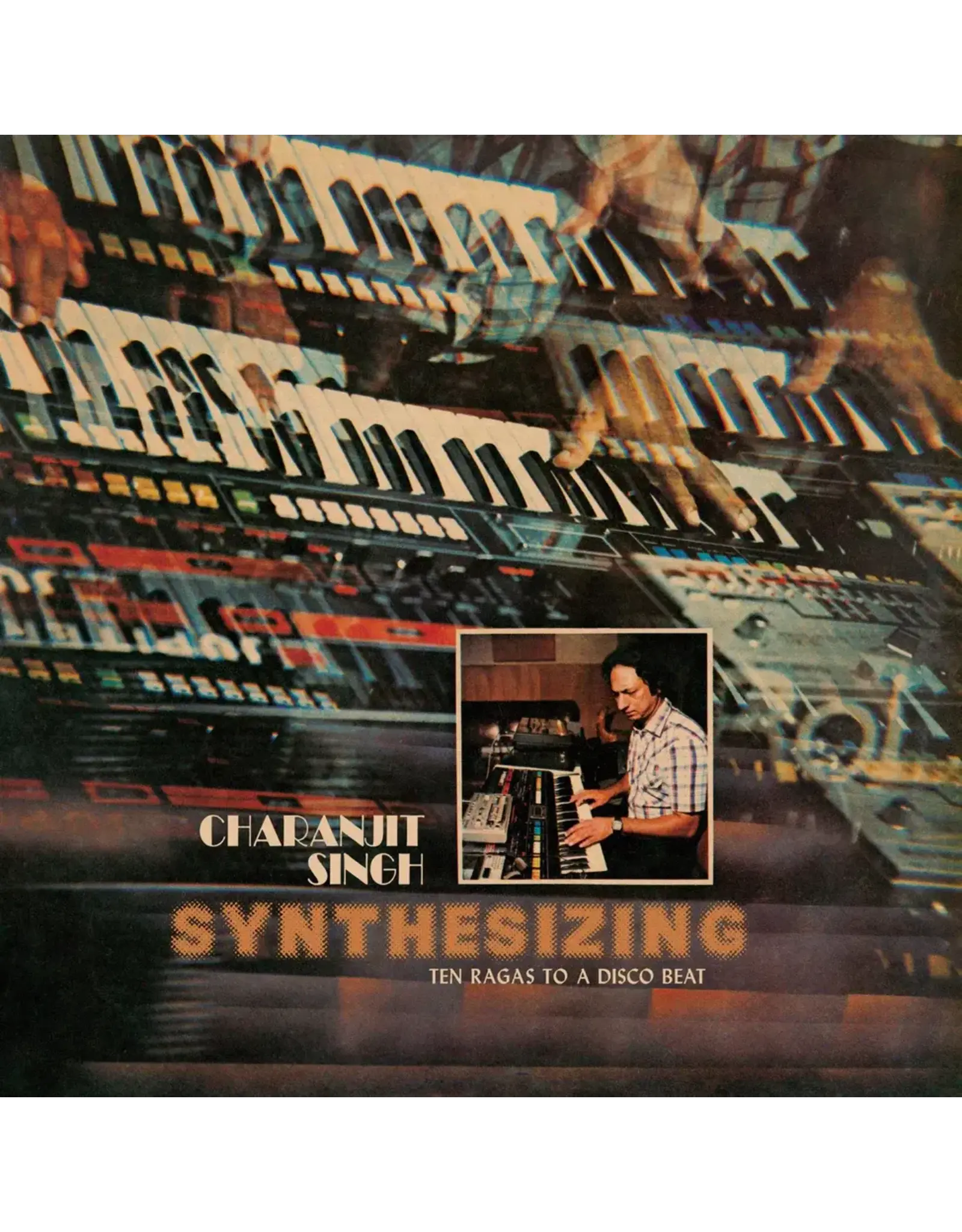
Light in the Attic is honored to announce the long-awaited reissue of Synthesizing: Ten Ragas to a Disco Beat, the revolutionary 1982 album from composer and musician Charanjit Singh. Pairing Indian classical ragas with then-state-of-the-art Roland synthesizers and drum machines, Singh created an electronic masterpiece that was far ahead of its time.
Recording live at Mumbai’s HMV studios, Singh married the past to the future—blending the ancient Indian tradition of ragas (a melodic framework, similar to a scale, from which musicians can improvise or compose) with pulsating, electronic dance beats. Released without fanfare, it faded into obscurity and Singh retired from recording to focus on private concerts, but that’s where the story begins…
Released in cooperation with Singh’s estate, Synthesizing: Ten Ragas to a Disco Beat arrives on June 26th. The 10-track album was remastered by Johanz Westerman at Ballyhoo Studio Mastering and stretched across 2-LPs for the highest quality listening experience. The vinyl was pressed at Optimal Media and housed in a gatefold jacket that replicates the original artwork.
An accompanying 16-page LP booklet features previously-unreleased photos and two new essays: the first from Arshia Fatima Haq and Jeremy Loudenback of Discostan—a multimedia collective and record label focusing on music from South West Asia and North Africa—while the other comes from filmmaker and writer Rana Ghose of event and film production entity REProduce Artists, who managed Singh in his final years and documented his triumphant return to the stage. Additionally, fans can find a limited-edition pressing of Synthesizing: Ten Ragas to a Disco Beat on ‘Pearlescent Transcendent Future’ Color Wax, while the album will also be reissued on CD with a 32-page booklet containing all of the above.
More on Synthesizing: Ten Ragas to a Disco Beat:
Indian multi-instrumentalist and composer Charanjit Singh (1940–2015) never intended to be an electronic dance music pioneer when he recorded 1982’s Synthesizing: Ten Ragas to a Disco Beat. Yet three decades later, his inventive use of state-of-the-art synthesizers and drum machines would prompt some to crown him the “Godfather of Acid House.” The real story, however, runs much deeper.
A native of Mumbai, Singh spent much of his career as a Bollywood session musician, collaborating with renowned composers like RD Burman and Shankar–Jaikishan, and appearing on some of the most iconic Hindi film hits of the ‘60s and ‘70s. Outside of the film industry, Singh recorded several of his own albums and toured the world alongside the era’s biggest stars—an opportunity which allowed him to collect new instruments, including synthesizers and other electronic devices. As psychedelia and disco wove their way into Bollywood scores, Singh was at the forefront, integrating a host of electronic textures into his work (his hypnotic Transicord introduction on “Dum Maro Dum” from 1971’s Hare Rama Hare Krishna is among his most recognizable performances).
By the turn of the ‘80s, however, Singh was disenchanted by the creative limitations of session work and embarked on a solo career. Not long after, on tour in Singapore, he discovered three Roland devices that had just hit the market: the TR-808 drum machine (released 1980), the TB-303 bass synthesizer (released 1981), and the Jupiter 8 synthesizer (released 1981). While this trio would fuel early electronic dance music in the coming years, Singh was among the first known artists to pair them on record when he was inspired to create his next album, Synthesizing: Ten Ragas to a Disco Beat.
Using only the three devices and recording live at Mumbai’s HMV studios, Singh married the past to the future—blending the ancient Indian tradition of ragas (a melodic framework, similar to a scale, from which musicians can improvise or compose) with pulsating, electronic dance beats, while programming the TB-303 to follow classical Hindustani scales. From the hypnotic drones of “Raga Bhairavi” to the uplifting jams of “Raga Bairagi” the album proved perhaps to be a bit too visionary for its time. Released without fanfare, it faded into obscurity and Singh retired from recording to focus on private concerts.
Two decades later, Dutch DJ and record collector Edo Bouman was in New Delhi when he came across an old copy of Ten Ragas. Bouman was astounded by what he heard—electronic music that had all the hallmarks of acid house, recorded five years before Chicago DJs coined the term. Bouman spent the next few years tracking down Singh and, in 2010, reissued the album on his label, Bombay Connection.
Soon, Ten Ragas became a viral sensation, sparking disbelief and debates about the origins of acid house. But, as Haq and Loudenback explain, those in the conversation “Had little frame of reference for [Singh’s] music outside of the parameters of western club music.” Viewed through the lens of the Hindi film industry, they argue, the album’s through-line comes into focus. In the ‘60s, when Western artists were looking to India for inspiration, Bollywood was “A laboratory for discovering sounds, and for harnessing every new technology that could be found or repurposed…. Singh’s album is more fittingly placed within the framework of the expansion of Bollywood’s experiments in disco, rather than that of acid house.”
“Perhaps this is yet another example of how a public engages with those who are ahead of their time,” adds Rana Ghose. “This record is a direct consequence of a centuries-old classical music form, rendered through the lens of a visionary who used the vanguard of technology at the time to recast it, resulting in an artefact that, almost 40 years later, is finding entirely new audiences in an era marked by a changing and uncertain global landscape of soft-power assertion. Considering this reassessment is as exciting as it is fascinating. Much like this record.”
While Ten Ragas sparked plenty of conversations within the electronic music community, it also gave a bemused Singh a surge of newfound fame during the final years of his life, allowing him to play to thousands of fans at packed club shows and festivals in Europe, the U.S., and India. Among those fans are Australian duo Glass Beams (who covered “Raga Bhairav”), German electronic duo Modeselektor, and Thom Yorke, who ranked “Raga Lalit” as one of his “6 Tracks You Need to Hear” via the BBC.
Most importantly, however, Ten Ragas resonated deeply with South Asian artists, who saw electronic music from India being recognized with new reverence. In the words of Vish Matre (of the UK DJ duo Dar Disku), “This record will be remembered for, not being the predecessor to another genre, but being a precursor to a lot of new music from the diaspora that relied on it as inspiration.”